
A HOUSEWAY2WEALTH FIELD NOTE · PART I OF A TWO-PART SERIES
The Truth About Trusts, LLCs, and Asset Protection
Why most investors think they’re protected… until they’re not.
- By Tony Robinson, Sr.
- Founder, HouseWay2Wealth™
- Creator of the E.A.T.S.™ System

It wasn’t the lawsuit that ruined him. It was believing he was protected when he wasn’t.”
I’ve seen that story play out more times than I care to remember. An investor buys a few rental properties. Business is good. Cash flow is coming in. Equity is growing. Life is moving in the right direction. He tells his friends at the investor meetup how well things are going. He starts looking at property number four, maybe number five. He feels, for the first time in his life, like he’s actually building something.
Then one day, the phone rings.
A tenant slips on a broken sidewalk. A contractor gets injured while replacing a water heater. A vehicle accident occurs while showing property to a prospective buyer. A fire damages a neighboring home and the fire marshal’s report points back to faulty wiring your handyman “fixed” two years ago. A lawsuit is filed.
Suddenly, the conversation changes from “How much equity do I have?” to “Can they take everything?”
Unfortunately, that question is usually being asked far too late. By the time an investor is Googling “asset protection” from a courthouse parking lot, most of the useful decisions have already been made — years earlier, often without anyone realizing a decision was even being made at all.
“It wasn’t the lawsuit that ruined him. It was believing he was protected when he wasn’t.
Most Investors Focus on Acquiring Assets. Few Focus on Protecting Them.
Real estate investors love talking about finding motivated sellers, creative financing, off-market deals, raising capital, cash flow, appreciation, and multiple
streams of income. Those conversations are exciting. They fill up conference rooms and Facebook groups. People show up early and stay late.
Asset protection? Not so much. Nobody rushes to the “entity structuring” breakout session at a real estate conference. It’s the room with the fewest chairs and the most empty seats — right up until something happens. One lawsuit. One unexpected event. One judgment. And suddenly years of hard work are placed under a microscope, usually by an attorney the investor didn’t choose and can’t afford to ignore.
What amazes me is that many investors will spend hundreds of hours learning how to acquire a property — studying comps, practicing scripts, driving neighborhoods, negotiating with sellers — yet spend almost no time learning how to protect what they’ve built. That’s backwards. It’s like spending a fortune building a beautiful home and never once asking whether the roof will hold up in a storm.
I’ve sat across the table from investors who could recite cap rates and cash-on-cash returns for every property in their portfolio without hesitation, yet couldn’t tell me which entity owned which property, whether their operating agreements were current, or when they’d last reviewed their insurance coverage. That’s not a knock on them — it’s simply where the industry’s attention has been for decades. Deal-finding gets the marketing budget.Protection gets an afterthought and a folder nobody opens.
One of the first principles I teach my mentorship students is this:
“Acquiring wealth and protecting wealth are two completely different skill sets. Successful investors learn both.”
FREE ASSET PROTECTION CHECKUP
Do You Know What's Actually Protecting You?
The Biggest Myth in Real Estate Investing
If I had to identify the single biggest misconception I hear from investors, it would probably be one of these three sentences. You’ve likely said one of them yourself, or heard someone say it with total confidence at a meetup, on a podcast, or in a YouTube comment section.
MYTH NO. 1: “I’ll just put everything in a trust.”
MYTH NO. 2: “My LLC protects everything.”
MYTH NO. 3 — MY PERSONAL FAVORITE: “Nobody can sue me because the property is in someone else’s name.”
None of those statements are entirely true. Unfortunately, those myths circulate through real estate clubs, social media, YouTube videos, and even some educational programs. People repeat them because they’ve heard them so many times they assume they’re facts. They’re not. And misunderstanding them can become extremely expensive — not in the form of a single bad month, but in the form of a single bad day that erases a decade of good ones.
Why These Myths Persist
“I’ll just put everything in a trust.” A trust is a planning tool that governs how assets are managed and who they pass to. By itself, moving a property into most common trusts does very little to shield it from a lawsuit arising out of that property — it simply changes who holds legal title and how it’s administered. Investors hear the word “trust” and assume it comes bundled with lawsuit-proof armor. It doesn’t. The armor, if it exists at all, comes from decisions made separately from the trust itself.
“My LLC protects everything.” An LLC can be a genuinely powerful liability tool — when it’s properly capitalized, properly documented, and properly operated as a separate business. The word “properly” is doing a lot of work in that sentence. An LLC that was formed online in fifteen minutes, has no operating agreement, commingles funds with a personal checking account, and skips annual formalities is a shell in more ways than one. Courts have a name for ignoring the separateness of a poorly run entity, and it isn’t a compliment to the investor who thought they were covered.
“Nobody can sue me because the property is in someone else’s name.” This one tends to create more problems than it solves. Whose name it’s in doesn’t erase the underlying facts of what happened, who was responsible, or what agreements exist behind the scenes. It can also create entirely new issues — around control, around financing, around what happens if that “someone else” has a falling out with you, gets divorced, gets sued themselves, or simply passes away. Anonymity and liability protection are related, but they are not the same thing, and confusing the two is one of the most common — and most costly — mistakes I see.
Let Me Say Something That May Surprise You
A trust is an incredible planning tool. An LLC is an incredible business tool. Neither is magic. There is no legal entity, no document, no filing, no strategy that creates an invisible force field around your assets. Asset protection doesn’t come from one document. It comes from an integrated strategy. That’s a very important distinction — and it’s the distinction most investors never get taught.
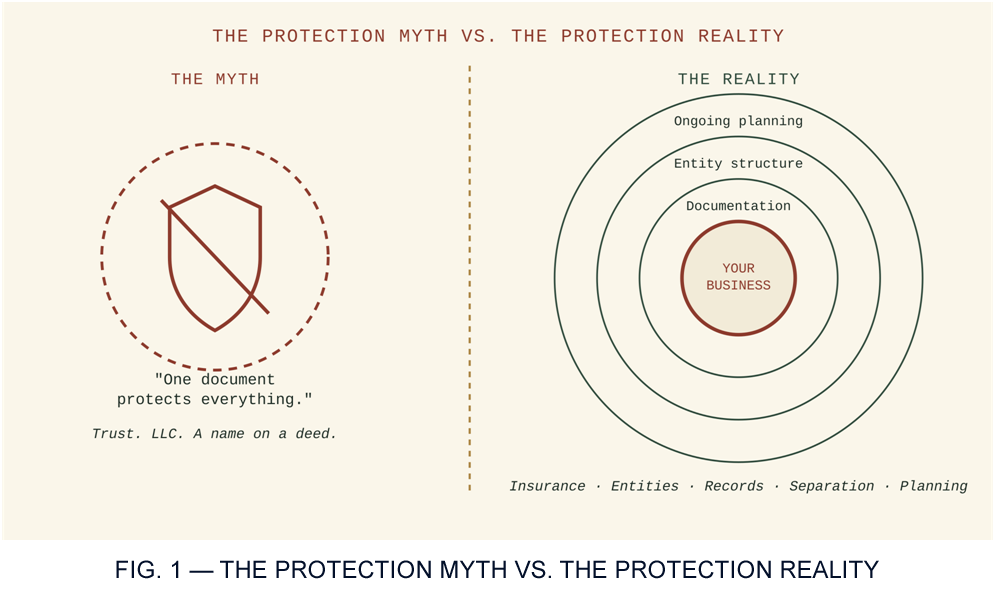
Protection Begins Long Before the Lawsuit
One of the mistakes investors make is believing asset protection begins after something bad happens. It doesn’t. Asset protection begins before you ever make an offer on your first investment property.
In fact, one of the questions I ask new investors isn’t “What are you buying?” It’s “Who should own it?” Notice I didn’t ask what should own it. I asked who. Because ownership structure is every bit as important as purchase price. Sometimes more. A great deal purchased into the wrong structure can become an expensive lesson. An average deal purchased into the right structure can quietly compound for decades without incident.
I’ve watched investors walk away from genuinely great deals because they hadn’t yet answered that ownership question, and I’ve watched other investors close on mediocre deals with total confidence because they knew exactly how the asset would be held, managed, and protected before they ever wired earnest money. The deal quality mattered less than the decision that came before it.
The HouseWay2Wealth Philosophy
At HouseWay2Wealth™, we don’t teach students to simply buy real estate. We teach them to build businesses. That’s an entirely different mindset. Businesses require structure, systems, documentation, separation, planning, and risk management.
- Structure
- Systems
- Documentation
- Separation
- Planning
- Risk management
Real estate investors often think about properties one at a time. Professional business owners think about portfolios. And portfolios require infrastructure. One of the greatest mistakes investors make is buying properties first, then trying to figure out entity structure later. That’s like building a house and deciding afterward where the foundation should go — you can try, but you’ll spend far more tearing out and redoing than you would have spent getting it right from the start.
FREE DOWNLOAD
Get the Foundation First Checklist
The E.A.T.S.™ Philosophy
One of the reasons I created the E.A.T.S.™ Workshop — Entity, Asset Protection, Trusts & Subject-To — was because I saw investors making the same mistakes over and over again. They would attend a weekend seminar, download an LLC online, create a trust they barely understood, then believe they were completely protected.
Education without understanding creates false confidence. And false confidence is dangerous. I wanted investors to understand not just how to create entities, but why those entities exist. Every structure should serve a purpose. Every entity should solve a specific business problem. Every trust should have a clearly defined objective. When you understand the purpose behind the structure, you stop collecting entities and start building an intentional business.
E
A
T
S
Entity is where we determine which type of business structure actually fits the asset in front of us — not the structure that’s trendy, the structure that fits. Asset Protection is where we step back from any single entity and look at the whole picture: insurance, capitalization, documentation, and the habits that either reinforce a structure or quietly undermine it. Trusts is where we talk about privacy, succession, and how assets are meant to move — during your life and after it. Subject-To rounds out the workshop because so many creative acquisitions involve existing financing, existing title, and existing risk that has to be accounted for the moment the deal closes, not months later. Each letter solves a different problem. Together, they stop being four separate tactics and start functioning as one coordinated system.
Think Like an Architect
One of my favorite analogies is this. Imagine hiring an architect to design your dream home. You don’t walk into the office and say, “Just start pouring concrete.” Of course not. The architect begins with questions. What are you building? How many people will live there? Will there be a second floor? What’s your budget? How do you plan to use the space?
Only after understanding the purpose does the architect begin drawing the plans. Your business deserves the same thoughtful approach. Too many investors begin pouring concrete before they’ve ever developed the blueprint — and concrete, once poured, is expensive to move.
I’ve never met an architect who designed a hospital, a single-family home, and a high-rise apartment building using the exact same blueprint. Each structure serves a different purpose, carries different loads, and faces different risks — and the plans reflect that. Yet I meet investors constantly who use the exact same ownership structure for a single rental, a house flip, a short-term rental, and a commercial property, simply because it’s the structure they set up first and never revisited. The blueprint should match the building. Not the other way around.

Every Asset Deserves an Interview
Just as every property deserves an interview before you determine how to acquire it, every asset deserves an interview before you determine where it belongs. Ask yourself:- Is this an investment property?
- Is this an operating business?
- Does this asset create liability?
- Does it create income?
- Who will manage it?
- What happens if I’m sued?
- What happens if I become incapacitated?
- What happens if I die?
The Difference Between Ownership and Control
One of the themes you’ll hear throughout my training is this: ownership and control are not always the same thing. Most people assume the person whose name appears on a deed has complete control over the property. Business owners know better.
Control can be established through carefully designed legal relationships — management agreements, operating agreements, trust agreements, and entity structures. Those relationships determine who makes decisions, who benefits financially, who bears responsibility, and how assets move from one generation to the next. Understanding those distinctions changes the way you look at every investment opportunity.
Here’s a simple way to picture it. Two investors each own a fourplex. On paper, their deeds look identical. One investor holds the property directly in his own name, manages it himself, signs every lease personally, and mixes rental income with his household checking account. The other holds the property inside a properly operated entity, with a management agreement that defines who makes decisions, an operating agreement that defines who benefits and in what proportion, and a clean separation between business and personal finances. The properties look the same from the street. The exposure behind them is nothing alike.
“Ownership and control are not always the same thing.”The Three Goals of Every Protection Strategy
Whenever I design an ownership structure, I’m generally trying to accomplish three objectives.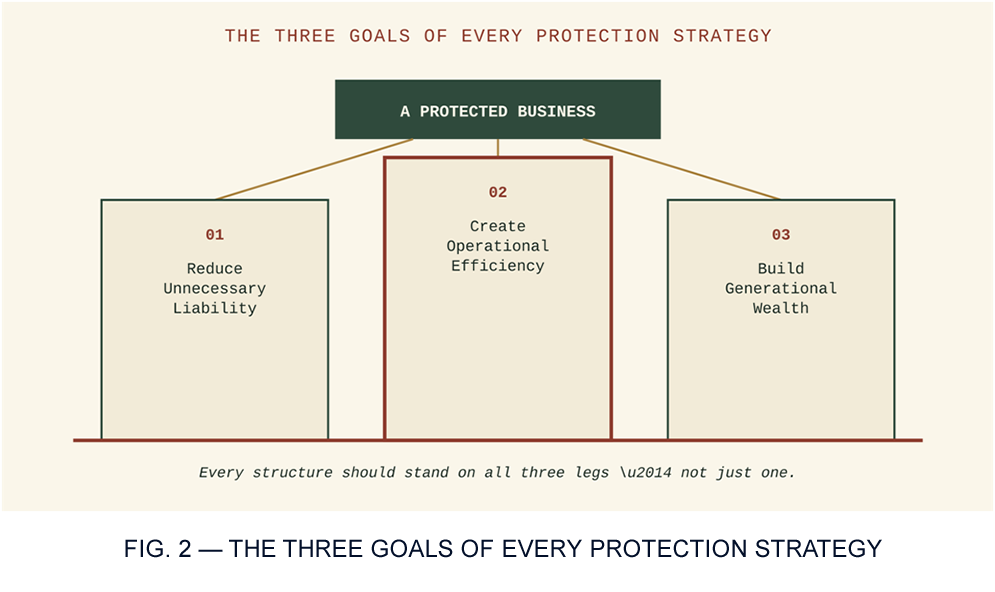
1. Reduce Unnecessary Liability
Every property carries risk. The goal isn’t to eliminate risk — that’s impossible. The goal is to prevent one unfortunate event from jeopardizing everything else you’ve built.
2. Create Operational Efficiency
Your ownership structure should make running your business easier. Not harder. If your entities create confusion, you’re probably overcomplicating things. Good planning creates clarity.
3. Build Generational Wealth
One day someone else will inherit the business you’ve spent decades building. Will they receive organized systems, or organized chaos? Asset protection isn’t just about lawsuits. It’s about stewardship. It’s about preserving what you’ve worked so hard to create.
THE E.A.T.S.™ WORKSHOP
Build All Three Legs — Not Just One
Asset Protection Is Really About Stewardship
This is where my philosophy differs from many educators. I don’t view asset protection as hiding assets. I view it as responsible stewardship. There’s an important difference — and it’s a difference worth sitting with, because a lot of what gets marketed as “asset protection” online leans hard on the first idea and ignores the second entirely.
Hiding assets is about concealment. It treats the legal system as something to be outmaneuvered, and it tends to fall apart under scrutiny at exactly the moment you need it to hold up. Stewardship is about something else entirely. It’s about running your business the way a responsible business owner runs any business — with records, with separation, with adequate insurance, and with entities that are actually respected as the separate legal persons they’re meant to be.
RESPONSIBLE STEWARDSHIP
- Maintain accurate records
- Separate business from personal affairs
- Properly capitalize your companies
- Maintain adequate insurance
- Use appropriate entities
- Follow corporate formalities
- Understand your legal obligations
- Operate ethically
NOT ON THE LIST
- Secrecy
- Deception
- Hoping no one notices
Professional investors don’t rely on gimmicks. They rely on sound planning.
Wealth Is Built in Stages
One of the mistakes new investors make is believing they need the same structure as someone who owns 500 rental properties. You don’t. Your business evolves. Your entity structure evolves. Your protection strategy evolves. The important thing is that your planning stays ahead of your growth. Not behind it. We have to also remember that “One Size Doesn’t Fit All.” The entity should be set up for what you are actually doing in your real estate business. Wholesaling in a disregarded entity or partnership could have massive unnecessary tax ramifications. Holding rentals in a S-Corporation could be problematic as well.
The investor with one rental property has a different set of needs than the investor with ten, and the investor with ten has a different set of needs than the investor with fifty. Trying to force a beginner into a fifty-door structure creates unnecessary cost and complexity. Trying to run a fifty-door portfolio through the same simple structure that worked for property number one creates unnecessary exposure. Neither extreme serves the investor. What serves the investor is a plan that’s built for where they are today, with a clear path for how it should evolve as the portfolio grows.
One of the goals of HouseWay2Wealth™ is helping investors build the right foundation at the right time, so they aren’t constantly restructuring after every acquisition — and so they’re never caught holding a portfolio that has quietly outgrown the structure protecting it.
A Story in Two Endings
Let’s go back to the investor from the beginning of this article — the one who watched years of hard work land under a microscope after a single lawsuit. His story doesn’t have to end the way you might expect, and I’ve watched it play out both ways enough times to know exactly what separates them.
In one version, he never asked “who should own this” before he bought. Every property sits in his personal name. There’s no operating agreement, no separate business bank account, no documented management structure — just a folder of closing documents and a hope that nothing ever goes wrong. When the lawsuit arrives, there’s no separation between the property that caused the claim and everything else he owns. The plaintiff’s attorney isn’t just looking at one asset. They’re looking at all of them.
In the other version, that same property sits inside a properly capitalized entity, with insurance sized to the actual risk, records that clearly separate business from personal, and a structure his attorney helped design before the first closing — not after the first lawsuit. When the same accident happens, it’s still a serious matter. It still requires attention, still requires his insurance carrier and his attorney. But the exposure has a boundary. One event affects one part of the business, not the entire life’s work behind it.
Same accident. Same lawsuit. Two completely different outcomes. The difference wasn’t luck. It wasn’t a clever trick discovered after the fact. It was a decision made — or not made — years earlier, when everything still felt calm and routine.
Coming in Part II
In the next section, we’ll separate fact from fiction and answer some of the most misunderstood questions in real estate investing:
- Does a trust actually provide asset protection?
- Why do so many investors misunderstand LLCs?
- What’s the difference between anonymity and liability protection?
- Should every property have its own LLC?
- What is a holding company, and why does it matter?
- Where do land trusts fit into a professional investor’s strategy?
- How do trusts and LLCs work together without creating a false sense of security?
We’ll also examine common mistakes investors make, explore practical ownership structures, and explain why asset protection isn’t about one magic entity — it’s about building a coordinated system.
Final Thoughts
The most successful investors I’ve met don’t just ask, “How can I buy more properties?” They ask, “How can I build something that will survive me?” That’s a very different question. It’s the question that transforms someone from a real estate investor into a business owner, and ultimately, into a legacy builder.
Because at the end of the day, the objective isn’t simply to accumulate assets. The objective is to build a business that protects those assets, provides for your family, and creates opportunities for generations to come.
“How can I build something that will survive me?”
Author’s Note: This article is intended for educational purposes and reflects general principles of business structuring and asset protection. Every investor’s circumstances are unique. Before implementing any legal, tax, or entity strategy, consult qualified legal and tax professionals licensed in your jurisdiction. The purpose of this article is not to provide legal advice, but to help investors ask better questions and build a stronger foundation for long-term wealth.