
HOUSEWAY2WEALTH FIELD NOTES · PART I OF A TWO-PART SERIES
property management is wealth management
- By Tony Robinson, Sr
- Founder, HouseWay2Wealth™
- Veteran Real Estate Investor
- Creator of the Property Wealth Management™ Philosophy
“The fastest way to destroy a great investment isn’t buying the wrong property. It’s managing the right property the wrong way.”
I’ve believed that for more than three decades. In fact, I’d argue that more fortunes have been quietly lost through poor property management than through bad acquisitions. That’s a bold statement. But I’ve watched it happen over and over again.
An investor buys a great property. The numbers work. The financing makes sense. The neighborhood is solid. The inspection is clean. Everything points toward success. He signs the closing documents feeling like the hard part is behind him.
Five years later, the property is underperforming. Maintenance has been deferred. Tenants have cycled through every year. Repairs cost more than they should. Collections are inconsistent. Vacancies are increasing. Cash flow is disappearing.
The investor blames the market. The economy. Interest rates. Inflation. Almost anything, except the real problem: poor management.
I understand the instinct. It’s uncomfortable to look at a property you were once proud of and admit the decline was self-inflicted. It’s much easier to blame forces outside your control. But the properties I’ve watched thrive over decades weren’t protected from bad luck, difficult tenants, or unexpected repairs. They were protected by an owner who treated management as seriously as acquisition — and that distinction alone tends to separate the investors who are still in the game ten years later from the ones who quietly sold at a loss and told everyone real estate “just wasn’t for them.”
“The fastest way to destroy a great investment isn’t buying the wrong property. It’s managing the right property the wrong way.”
Most Investors Think Property Management Begins After Closing
It doesn’t. Property management begins before you ever purchase the property. That may sound strange. But think about it — every decision you make before closing affects what happens afterward.
- Did you buy the right neighborhood?
- Did you understand deferred maintenance?
- Did you evaluate future capital expenditures?
- Did you understand the tenant profile?
- Did you budget for turnover?
- Did you inspect the plumbing, the HVAC, the roof, the foundation?
The management process begins long before the first lease is signed. That’s why I often tell my students: the best property managers are actually excellent acquisition specialists. Because they’re buying tomorrow’s management experience today. Every red flag you wave off during due diligence doesn’t disappear — it simply moves down the calendar and waits for you, usually with interest.
FREE PROPERTY MANAGEMENT AUDIT
Is Your Property Trying to Tell You Something?
A Rental Property Is Not Passive. It’s a Business.
One of the biggest lies ever told in real estate is this: “Rental properties produce passive income.” I disagree. Rental income only becomes passive after you’ve built systems. Until then, it’s very active.
- Phones ring
- Water heaters leak
- HVAC systems fail
- Trees fall
- Tenants divorce
- Jobs are lost
- Pets destroy flooring
- Insurance claims happen
- City inspectors show up
- HOAs send violation letters
- Vendors miss appointments
- Rent checks bounce
There’s nothing passive about any of that. Unless you build systems. That single word — systems — is the entire difference between an investor who dreads their phone ringing and an investor who barely notices it anymore.
The confusion is understandable. “Passive income” is a phrase built for marketing, not for accuracy. It sells courses and books far better than the more honest version: “income that becomes passive once you’ve done the unglamorous work of building a business around it.” Investors who skip that unglamorous middle step and go straight from purchase to expecting passivity are almost always the ones who end up disillusioned by year three.
HouseWay2Wealth Doesn’t Teach Property Management. We Teach Business Management.
That’s an important distinction. Most landlords manage tenants. Professional investors manage businesses. Businesses require:
- Policies
- Procedures
- Documentation
- Accountability
- Communication
- Financial controls
- Performance measurement
Those aren’t simply management tasks.
They’re the foundation of every successful business.
Whether you’re operating a Fortune 500 company or a portfolio of five rental properties, the principles are remarkably similar. Businesses don’t thrive because they have great products alone. They thrive because they have systems that consistently produce great results.
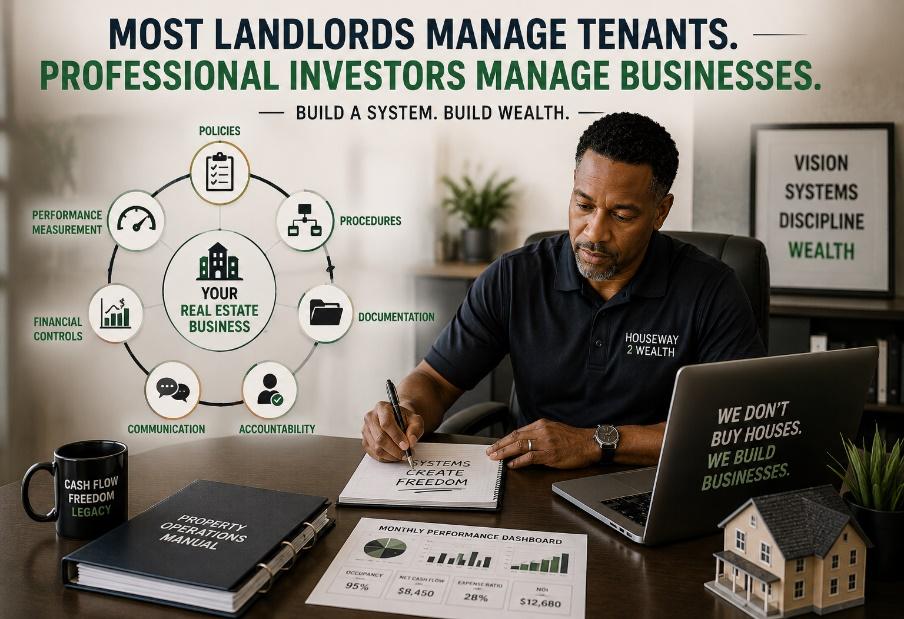
Policies establish expectations before misunderstandings occur.
Procedures create consistency so important tasks are performed correctly every time.
Documentation protects the business while preserving knowledge that doesn’t disappear when people do.
Accountability ensures everyone understands both their responsibilities and the standards by which performance is measured.
Communication keeps tenants, vendors, contractors, and team members informed while reducing confusion and unnecessary conflict.
Financial controls protect cash flow, identify inefficiencies, and provide the information necessary to make sound business decisions.
Performance measurement allows you to evaluate what is actually happening within your business rather than relying on assumptions or intuition.
Collectively, these systems transform what many people call a “rental property” into a professionally managed business.
Properties simply become one part of that business.
That’s why I rarely ask investors,
“How many rentals do you own?”
Instead, I ask,
“How well does your business operate?”
Those are two completely different questions.
After more than thirty years of investing, mentoring, and managing real estate, I can usually predict an investor’s five-year outcome far more accurately from the second answer than the first.
I’ve met investors who owned only three rental properties but operated with written policies, standardized inspection procedures, documented maintenance systems, preferred vendor relationships, monthly financial reviews, reserve planning, and clearly defined performance standards. Every aspect of their business had purpose. Every process had consistency. Nothing depended solely on memory or guesswork.
I’ve also met investors who owned thirty or forty rental properties who couldn’t tell me which units were producing the strongest returns, which leases were approaching expiration, how much they spent annually on maintenance, or whether their reserve accounts could withstand a major capital expense. From the outside, the portfolio appeared impressive. Behind the scenes, however, the business was operating in a constant state of reaction.
The difference wasn’t intelligence.
It wasn’t experience.
It wasn’t access to capital.
It was operational discipline.
Door count tells me something about ambition.
It tells me very little about operational excellence.
Owning more properties doesn’t automatically make someone a better investor any more than owning more trucks makes someone a better transportation company.
Growth doesn’t solve operational problems.
Growth magnifies them.
Weak systems become weaker.
Poor communication becomes more costly.
Financial mistakes become larger.
Small inefficiencies become significant drains on profitability.
Conversely, strong systems become stronger.
Every additional property becomes easier to integrate because the business already has the infrastructure to support growth.
That’s why the investors who scale successfully almost always follow the same sequence.
They build the operating business first.
Then they build the portfolio.
Never the other way around.
One of my favorite sayings is:
“Don’t build a portfolio your business isn’t prepared to support.”
Because wealth isn’t created by the number of doors you own.
It’s created by the quality of the business operating behind those doors.
Once you begin viewing every property as one division of a larger enterprise instead of an isolated investment, your decision-making changes.
You stop asking,
“Can I afford another rental?”
Instead, you begin asking,
“Does my business have the systems, financial controls, people, processes, and operational capacity to support another property without compromising the ones I already own?”
That’s the question professional investors ask.
And it’s one of the reasons their businesses continue to grow while so many landlords eventually become overwhelmed by the very portfolios they worked so hard to build.
The Property Is Not Your Investment. Your System Is.
This surprises people. The house isn’t your competitive advantage. Anyone can buy the same house. Your management system — that’s where wealth is created.
Imagine two investors buying identical duplexes on the same street. Same purchase price. Same financing. Same rents. Five years later, the outcomes look nothing alike.
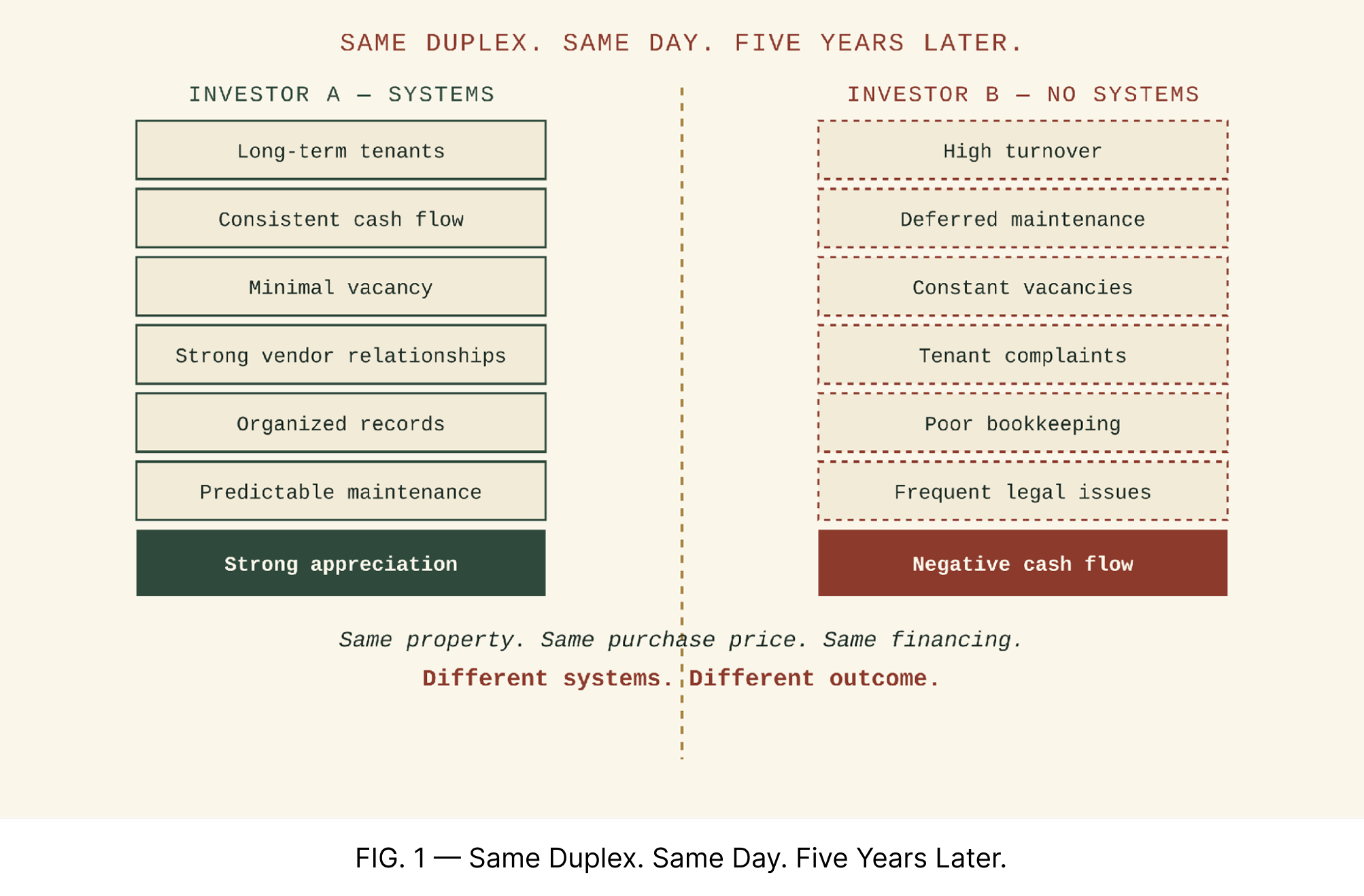
Same property. Different systems. Different outcome. Nothing about the dirt or the drywall changed between these two duplexes. What changed was everything that happened after the closing table.
FREE DOWNLOAD
See Which Investor You're Becoming
Every Property Is a Small Business
One of the philosophies I teach inside HouseWay2Wealth™ is this: stop looking at your rental property as a house. Start looking at it as a company. Companies have:
- Income
- Expenses
- Employees
- Vendors
- Customers
- Policies
- Marketing
- Risk
- Compliance
- Maintenance
- Cash reserves
- Growth strategies
Your rental property has every one of those things. The only difference is that many landlords never think of it that way. They think of it as a house that happens to generate a check — and then they’re surprised when a business-sized problem shows up expecting a business-sized response they never prepared.
Think about what happens when a real company loses a customer. Leadership asks why. They review the data, adjust the process, and document the lesson so it doesn’t repeat. Now think about what happens when the average landlord loses a tenant. Most simply re-list the unit and hope the next one stays longer — with no review, no adjustment, and no documented lesson. Same event. Two entirely different responses. Only one of them is actually running a business.
Your Tenants Are Not Your Problem. They’re Your Customers.
This idea changes everything. I’m amazed how often I hear landlords refer to tenants as if they’re adversaries. “They’re always calling.” “They’re always complaining.” “They’re always asking for something.”
Let me ask a different question. How would Amazon respond if customers stopped calling? How would Chick-fil-A react if customers disappeared? Every successful business exists because it serves customers. Rental housing is no different.
Now, that doesn’t mean we tolerate late payments, lease violations, property damage, or disrespect. Professional management requires accountability. But accountability and professionalism can exist together. The goal isn’t simply to collect rent. The goal is to provide quality housing while operating a profitable business. Those two objectives are not mutually exclusive. In fact, they support one another.
I’ve noticed something interesting over the years: the properties with the fewest legal issues are almost never the properties with the strictest owners. They’re the properties with the clearest communication. A tenant who knows exactly how to reach you, what to expect from a maintenance request, and what the lease actually requires is far less likely to end up in a dispute than a tenant who’s left guessing. Clarity isn’t softness. It’s professionalism — and it happens to be good for the bottom line too. Another issue that is common with investors is many rarely seek to understand and gain knowledge of the landlord – tenant laws in their respective state. More alarming is many do not know or understand what their lease says. That’s a significant problem when you have black ink on white paper and your tenant is more aware of what your responsibilities and what the law says than you do.

Property Management Is Really Risk Management
When people hear the words “property management,” they immediately think: collect rent. I think much bigger. Property management is really the management of risk — financial risk, legal risk, maintenance risk, reputation risk, operational risk, human risk.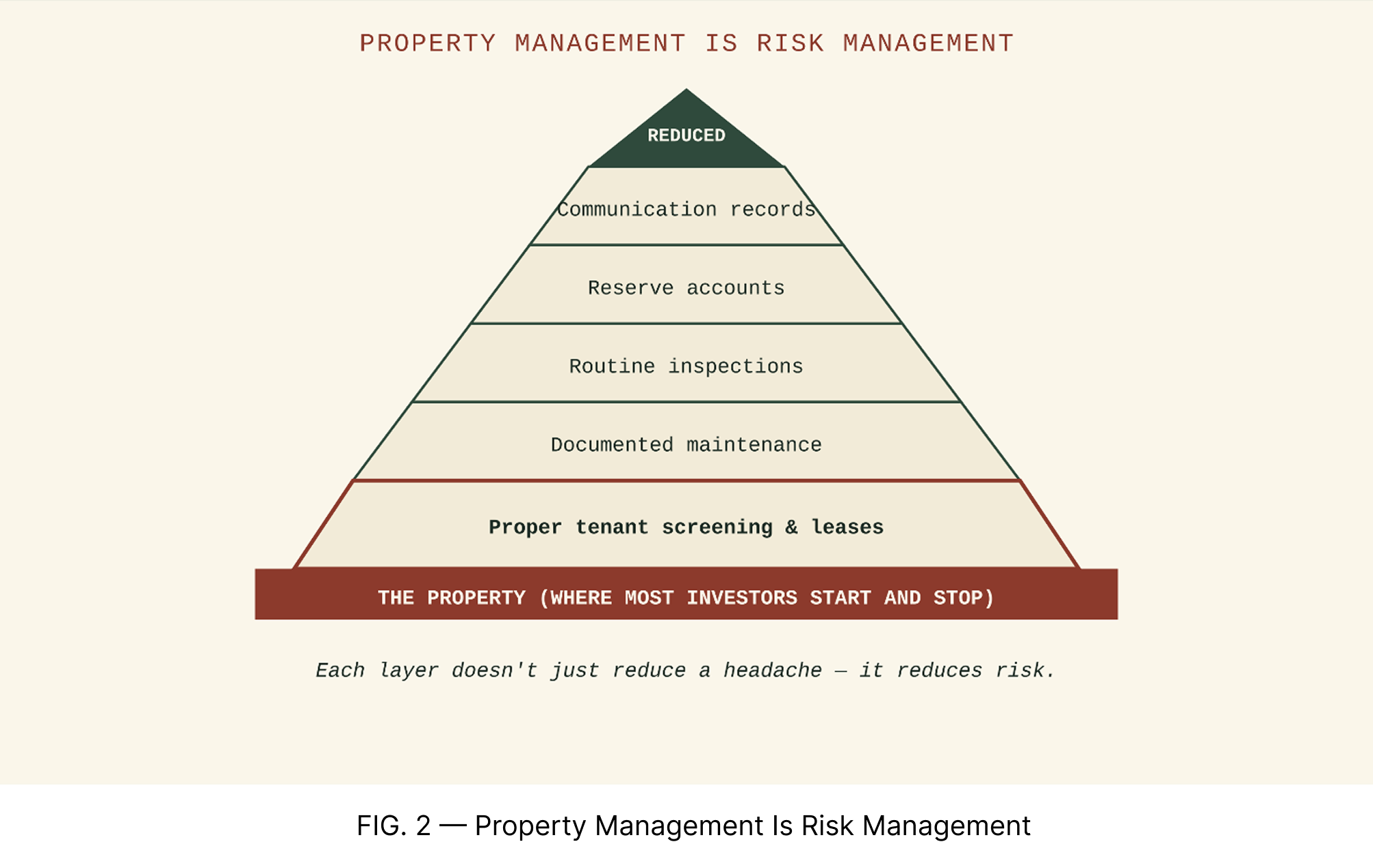
Financial risk is the obvious one — vacancy, non-payment, unexpected capital expenses. Legal risk shows up in leases that were never reviewed, notices that were never documented, and fair housing missteps that felt harmless in the moment. Maintenance risk is every deferred repair quietly getting more expensive in the background. Reputation risk is the online review, the word-of-mouth warning in a tight rental market, the applicant who never called back after hearing how a previous tenant was treated. Operational risk is what happens when the one person who knows how everything works goes on vacation, gets sick, or simply burns out. And human risk — the one investors think about least — is the reality that tenants, vendors, and even property managers are people, with good days and bad ones, and a system that assumes perfect behavior from everyone involved is a system waiting to be disappointed.
Every inspection reduces risk. Every documented conversation reduces risk. Every lease clause reduces risk. Every maintenance record reduces risk. Every properly screened tenant reduces risk. Every reserve account reduces risk. Good property management isn’t reactive. It’s preventative — and prevention, unlike a lawsuit or an emergency repair, never shows up as a dramatic story. It just quietly saves you from having one.
HOUSEWAY2WEALTH™ PROGRAMS
Build the Risk- Reduction Layers
The Cost of Deferred Decisions
Notice I didn’t say deferred maintenance. I said deferred decisions. Most expensive repairs don’t happen because someone ignored a leaking faucet. They happen because someone ignored a decision. “I’ll deal with it later.” “I’ll wait until next month.” “It probably isn’t that bad.”
Those small decisions compound. Wealth compounds too. The question is — which one are you compounding? I’ve watched a two-hundred-dollar plumbing repair, deferred for eight months out of convenience, turn into a four-thousand-dollar subfloor replacement, a displaced tenant, and a month of lost rent. The faucet never got more expensive. The decision did.
Run that math across a portfolio instead of a single unit and the pattern becomes impossible to ignore. An investor who defers a handful of small decisions every year isn’t looking at a handful of small costs — they’re looking at a compounding maintenance liability that grows quietly in the background while the monthly financial statement still looks perfectly fine. The balance sheet doesn’t show deferred decisions. It only shows their consequences, usually months after the decision that caused them.
Every Maintenance Call Is Telling You a Story
One of the habits I’ve developed over the years is asking one simple question whenever maintenance becomes repetitive: “What is this property trying to tell me?”
Repeated plumbing problems — maybe it’s not the tenant. Maybe it’s the entire supply line. Multiple HVAC repairs — perhaps replacement is now the better financial decision. High tenant turnover — maybe the issue isn’t marketing. Maybe it’s management.
Properties communicate. Professional investors listen. The investor who treats every third service call as a coincidence will keep paying for the same problem in a different disguise. The investor who treats it as a pattern gets to solve it once.
I once had a student convinced her fourplex simply attracted “bad luck” tenants — every unit seemed to churn faster than the others in her portfolio. When we finally sat down with her maintenance log, the pattern wasn’t luck at all. Every unit that turned over quickly shared the same undersized water heater, and every one of those tenants had submitted at least one complaint about lukewarm showers before they gave notice. The property wasn’t cursed. It had been telling her the same story for two years. She just hadn’t been asked to listen for it yet.
Systems Create Freedom
People often tell me, “I got into real estate so I wouldn’t have to work.” I understand. But freedom isn’t created by buying more rentals. In fact, more properties without the proper systems can create more work, more stress, and more demands on your time. Freedom is created by building better systems.
- Documented procedures
- Preferred vendors
- Inspection schedules
- Maintenance reserves
- Communication templates
- Tenant onboarding
- Move-out checklists
- Financial dashboards
- Performance reviews
A system does not have to be complicated to be effective. It simply needs to be clear, repeatable, and understood by everyone involved. When the same task is handled consistently each time, fewer details are missed, fewer problems become emergencies, and the owner is no longer required to personally solve every issue.
These systems create consistency, reduce unnecessary decisions, prevent repeated mistakes, and make the business less dependent on the owner. They help ensure that maintenance is handled properly, tenants receive consistent communication, vendors understand expectations, and financial performance can be measured rather than guessed.
Businesses that run without constant owner intervention — that’s the goal. Not more doors. Better operations. An investor with five well-run doors often has more actual freedom than an investor with twenty-five chaotic ones. The true measure of freedom isn’t how many properties you own. It’s how well those properties continue to operate when you’re not personally managing every detail
Professional Management Has a Rhythm
One of the clearest differences between a landlord and a real estate business owner is rhythm. A landlord operates in bursts — long stretches of nothing followed by frantic activity the moment something breaks. A professionally managed portfolio operates on a cadence, whether or not anything has gone wrong that week.
- Weekly: collections review, open work orders, vacancy pipeline
- Monthly: financial statement review, reserve contribution, vendor performance
- Quarterly: property walkthroughs, lease renewal planning, insurance review
- Annually: capital expenditure planning, rent benchmarking, policy updates
None of those touchpoints require a crisis to justify them. That’s the point. A business that only pays attention when something breaks will always be one step behind. A business with a rhythm catches the slow drain before it becomes the flooded kitchen — because someone was already scheduled to be paying attention that week, crisis or not.
Playing Monopoly in Real Life™
People often ask why I teach with a Monopoly board. Here’s why. Nobody wins Monopoly because they collect one rent payment. They win because they improve assets, protect assets, manage assets, increase revenue, reinvest profits, and build an expanding system.
Watch a skilled Monopoly player and you’ll notice something: they’re not just excited to land on a property. They’re already thinking about houses, then hotels, then trades that strengthen their position across the board. The player who buys a property and does nothing else with it almost never wins — even if they owned some of the best real estate on the board. Ownership alone was never the winning move. Development and management were.
Real estate works exactly the same way. Buying the property only gets you onto the board. Management determines whether you stay in the game.
Stewardship Creates Wealth
This is where my philosophy differs. Property management isn’t just operational. It’s stewardship. You’re managing someone’s home, someone’s investment, someone’s future. Sometimes, all three belong to you.
Professional investors recognize that every decision today affects the value of tomorrow’s portfolio. That’s stewardship. It shows up in the small moments nobody’s watching — approving a repair before it’s requested twice, keeping a promise about a move-in date, being honest with yourself about a property’s real condition instead of the condition you’d prefer it to be in. None of those moments show up on a pro forma. All of them show up in the value of what you’re building.
“You’re managing someone’s home, someone’s investment, someone’s future. Sometimes, all three belong to you.”
Wealth Isn’t Built During Closing. It’s Built Every Month Afterward.
The closing table is exciting. The real work begins the next morning. That’s when wealth is either created, or quietly destroyed — one rent payment at a time, one inspection at a time, one maintenance decision at a time, one policy at a time, one relationship at a time, one system at a time.
I’ve never once seen a portfolio’s value determined at a closing table. I’ve seen it determined in the eleventh month of a lease, when a renewal conversation either keeps a good tenant in place or sends them shopping. I’ve seen it determined in a five-minute inspection that catches a roof issue while it’s still a five-hundred-dollar repair instead of a five-thousand-dollar one. Closing day makes headlines. The eleven hundred ordinary days after it make the actual return.
Same Phone Call. Two Different Investors.
Let me bring this down to a single Tuesday afternoon. A tenant calls to report a slow drain in the kitchen sink. It’s a small thing. Easy to brush off. But how two different investors handle that one phone call tends to predict how their entire portfolio will look five years from now.
The landlord-minded investor tells the tenant to try a bottle of drain cleaner and see if it helps. No note is taken. No work order is created. Three weeks later, the same tenant calls again — this time the drain isn’t slow, it’s backed up, and water has started coming up through the tub instead. A plumber is called on an emergency basis, at an emergency rate, and discovers the real issue was a partially collapsed line that had been building toward failure the entire time. The investor pays triple what the original fix would have cost, loses a day of the tenant’s goodwill, and still doesn’t write anything down.
The CEO-minded investor logs the same first call the moment it comes in. A vendor is scheduled within 48 hours, not because the drain is an emergency, but because slow drains are a known early warning sign worth taking seriously. The technician finds early root intrusion, clears it, and notes the pipe material and age in the property file. Six months later, when a neighboring unit reports a similar issue, the investor already knows to check the same line — because the story has already been told once, and this time, someone was listening.
Same phone call. Same Tuesday afternoon. Completely different five years ahead of them.
Coming in Part II
In the next installment of this series, we’ll move from philosophy into practice and walk through what Property Wealth Management™ actually looks like on the ground:
- What belongs in a tenant onboarding system, start to finish?
- How should investors budget and staff for maintenance and turnover?
- What does a proper inspection cadence look like at 1 door versus 20?
- When should an investor self-manage, and when does a property manager pay for itself?
- What financial dashboards should every rental business track monthly?
- How do you build vendor relationships that don’t fall apart under pressure?
We’ll get specific about the systems, checklists, and reserve targets that turn “property management” from a chore into a genuine wealth-building discipline.
Final Thoughts
The investors who build lasting wealth don’t simply buy properties. They build organizations capable of managing those properties with consistency, professionalism, and purpose. That’s why I believe Property Management Is Wealth Management™.
Because every lease signed, every repair authorized, every vendor hired, every inspection completed, every policy enforced, and every tenant relationship managed either strengthens, or weakens, the long-term value of your business.
When you stop thinking like a landlord and start thinking like the CEO of a real estate company, everything changes. You stop reacting to problems. You start designing systems. You stop chasing rent. You start building wealth. And that’s exactly what we teach inside HouseWay2Wealth™.
None of this requires you to already own fifty doors, hire a full-time staff, or overhaul your entire portfolio by next Monday. It simply requires a decision — the same kind of decision that separates the investor whose properties quietly compound in value for thirty years from the investor who sells at a loss and calls it bad luck. That decision is available to you at any portfolio size, starting with the very next maintenance call you take.
“You stop reacting to problems. You start designing systems. You stop chasing rent. You start building wealth.”